
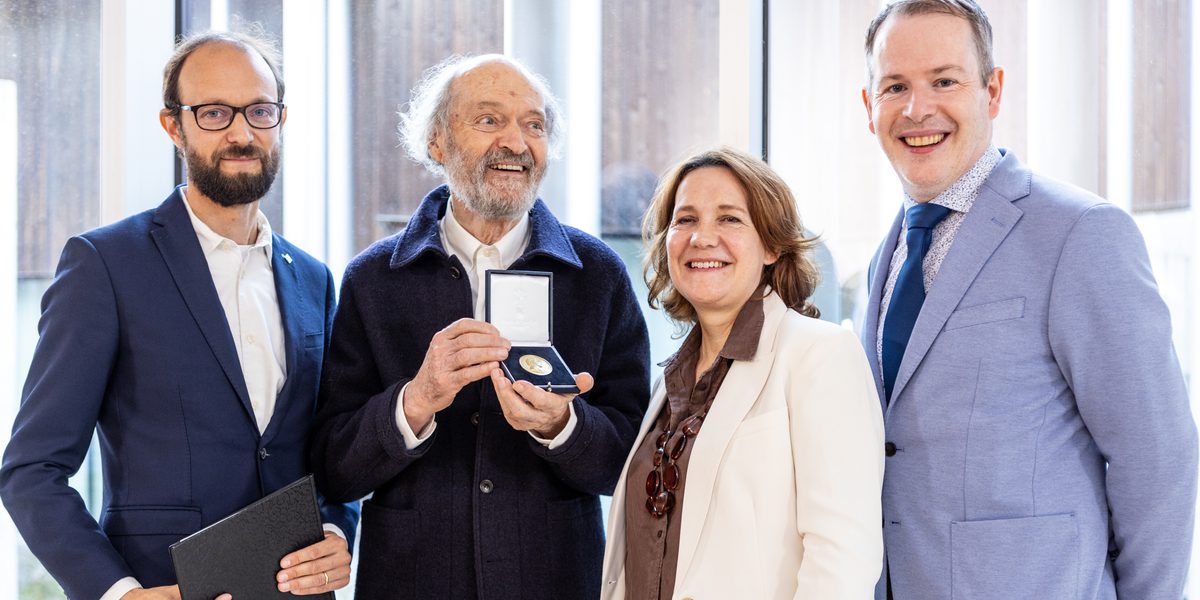
Michael Pärt's speech at the presentation of the RPS Gold Medal to Arvo Pärt
On 12 September 2024, we were delighted to present the RPS Gold Medal to the great composer Arvo Pärt. At the presentation, which took place at the Arvo Pärt Centre in Estonia, his son Michael Pärt said the following words, linking his father's music to English musical traditions.
For our full news story about the event, click here.
'Ladies and gentlemen, esteemed members of the Royal Philharmonic Society, dear friends of the Arvo Pärt Centre,
It is a profound honour to stand before you today, as we gather to celebrate the contribution my father, Arvo Pärt, has made to the world of music. On behalf of my father, I would like to express our deepest gratitude for this prestigious recognition, the Royal Philharmonic Society Gold Medal.
Music, as you know, is not just about sound, but a deep connection between the past and the present, between cultures and traditions, and between individual experiences. In my father’s work, this connection is embodied in the way he draws from early music traditions while creating something contemporary. And among the many traditions that have shaped his music, English choir music holds a very special place.
As a composer, my father’s journey towards his unique musical language - the tintinnabuli style - was not immediate. It was a journey of creative and spiritual exploration. His close connection with the sacred text, which is at the heart of his music, has been shaped by a profound reverence for choral and vocal traditions— traditions deeply rooted in the English early music. This bond becomes even more evident when we look at his collaborations with the renowned vocal ensemble, The Hilliard Ensemble, and their founder, Paul Hillier. Through their interpretations of Arvo's music, a new dialogue was forged between old and new, past and present.
Paul Hillier has described how my father’s tintinnabuli style echoes the ringing of English church bells, with its subtle, evolving changes that create a sense of timelessness. This comparison highlights how my father’s music, though distinctly his own, resonates with the simplicity and spiritual depth found in early English music, returning to the fundamentals, to the beauty of a single note, a single word, or a single phrase.
This Gold Medal is not just an award; it is a recognition of that timeless quality in his music, a music that is deeply connected to the traditions while also remaining utterly personal, utterly unique. My father is deeply moved by this honour, and he is thanking you all from the bottom of his heart, for this great recognition.'